IVR for Business in India: What It Is, How It Works & How to Choose the Right IVR System

When customers call a business, they expect to reach the right person quickly. But if every incoming call has to be answered manually, your team can spend valuable time transferring calls, answering repetitive questions, and dealing with calls outside business hours.
This is where IVR for business becomes useful.
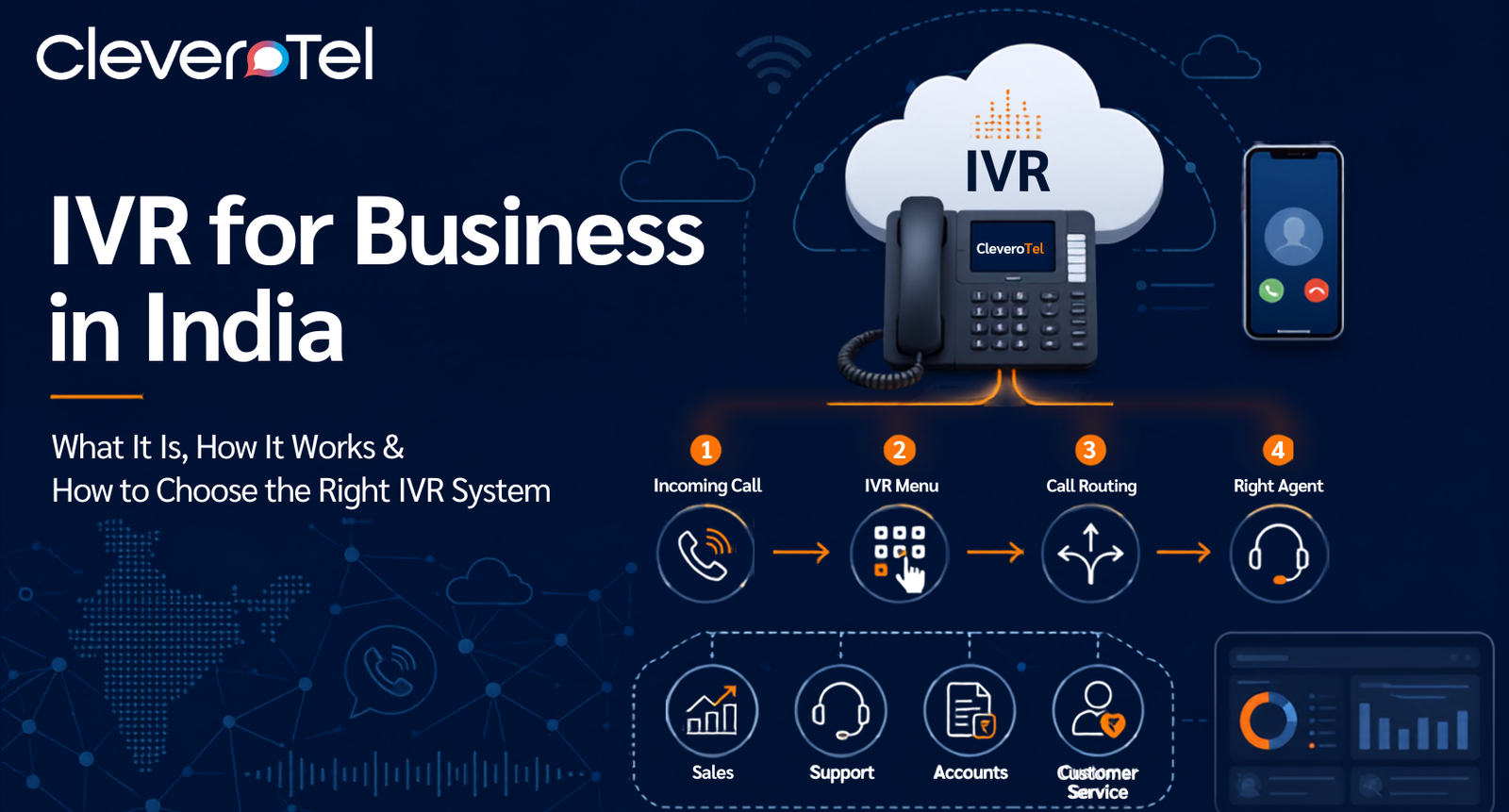
IVR, or Interactive Voice Response, is an automated phone system that interacts with callers through keypad inputs or voice commands. It can greet customers, provide menu options, collect information, route calls to the right department, and even handle simple requests without requiring a live agent.
For Indian businesses, modern cloud IVR can also support multilingual menus, remote teams, call recording, analytics, CRM integrations and intelligent call routing.
In this guide, you’ll learn what an IVR system is, how it works, its benefits, important features to look for, and how to choose the right IVR system in India.
What Is IVR for Business?
An IVR for business is an automated telephone system that guides callers through a predefined menu and connects them with the appropriate department, employee or service.
For example, when a customer calls a company, they might hear:
“Welcome to ABC Business. Press 1 for Sales, Press 2 for Support, Press 3 for Accounts.”
The caller selects an option using the phone keypad or, with more advanced systems, by speaking a command.
The IVR then processes the selection and routes the call accordingly.
Modern IVR systems can work with cloud telephony, automatic call distribution (ACD), CRM platforms and business applications to create a complete customer communication workflow.
For Indian businesses, cloud-based IVR is particularly useful because companies can manage call flows without maintaining traditional PBX hardware.
How Does an IVR System Work?
A typical business IVR follows a simple process:
1. Customer calls your business number
The customer calls your virtual business number, toll-free number or existing business number.
2. IVR answers automatically
Instead of waiting for a receptionist, the system immediately plays a welcome message.
For example:
“Thank you for calling XYZ Technologies. Please select an option to continue.”
3. Caller selects an option
The caller can press a number on the keypad or, depending on the system, respond using voice commands.
Traditional systems commonly use DTMF keypad signals, while newer systems can incorporate speech recognition and natural language processing.
4. The call is routed
The IVR sends the caller to the appropriate department or agent.
For example:
- Press 1 → Sales
- Press 2 → Customer Support
- Press 3 → Billing
- Press 4 → Technical Support
5. The system can provide self-service
Not every call needs an employee.
An IVR can provide information such as business hours, appointment details, order status or other predefined information.
6. Unanswered calls can follow an alternative route
If agents are unavailable, the system can send the caller to voicemail, another department, a callback queue or an after-hours workflow.
This helps reduce missed calls and gives businesses more control over customer communication.
Why Do Businesses in India Need IVR?
An IVR system is not only a call-routing tool. When designed correctly, it becomes part of the overall customer experience.
1. Professional customer experience
A structured IVR menu makes even a small business sound organized and professional.
Instead of one employee answering every call, customers can immediately select the department they need.
2. Faster call routing
Calls can automatically reach Sales, Support, Accounts, HR or another department without requiring a receptionist to manually transfer every caller.
3. 24/7 availability
Your business doesn’t have to stop communicating when employees leave the office.
An IVR can provide after-hours messages, voicemail, callback options and other automated workflows.
4. Reduced workload for employees
Routine calls and frequently requested information can be handled automatically, allowing employees to focus on conversations that require human attention.
5. Better handling of high call volumes
During campaigns, promotions or busy periods, multiple customers can interact with the IVR while calls are distributed among available agents.
6. Multilingual customer support
India has a highly diverse customer base. A good IVR platform should allow businesses to create menus and recordings in languages relevant to their customers.
Modern Indian cloud IVR platforms increasingly emphasize multilingual support as a key requirement.
7. Call tracking and analytics
Cloud IVR platforms can provide information such as call volume, missed calls, call duration, routing patterns and agent performance.
These insights can help businesses identify peak calling hours and improve staffing and customer service.
Important IVR Features to Look For
Not every IVR system offers the same capabilities. Before choosing an IVR provider in India, consider these features:
Multi-Level IVR
A multi-level IVR lets businesses create multiple menus.
For example:
Sales → New Enquiry → Product A / Product B
Support → Existing Customer → Technical Support / Billing
This is particularly useful for larger organizations.
Smart Call Routing
Look for routing based on department, agent availability, business hours, skills or other rules.
Business-Hour Routing
Your IVR should behave differently during working hours, weekends and holidays.
For example, during office hours calls can go to employees, while after hours they can be redirected to voicemail or a callback workflow.
Call Recording
Call recording can help with employee training, quality monitoring, customer dispute resolution and compliance requirements where applicable.
CRM Integration
CRM integration can connect incoming calls with customer records.
Platforms such as CleveroTel support integrations with business applications and CRM/helpdesk systems, helping teams connect communication data with their existing workflows.
Analytics
Choose an IVR platform that provides useful reports rather than simply showing the number of calls received.
Look for metrics such as missed calls, waiting time, call duration, agent performance and call trends.
Mobile and Remote Access
For businesses with remote or field teams, employees should be able to handle business calls without being physically present in the office.
AI and Voice Automation
Traditional IVR relies heavily on numbered menus.
AI-powered voice systems can go further by understanding natural language and helping callers complete tasks without navigating long phone trees.
However, businesses should not automatically replace every IVR menu with AI. The right approach depends on call volume, customer needs, complexity and the type of automation required.
Cloud IVR vs Traditional IVR
Traditional IVR systems are often connected to on-premise PBX infrastructure, whereas cloud IVR is hosted by a cloud communications provider.
| Feature | Traditional IVR | Cloud IVR |
|---|---|---|
| Hardware | Usually required | Minimal/no on-site hardware |
| Remote management | Limited | Yes |
| Scalability | Hardware-dependent | Easier to scale |
| Call analytics | May require additional systems | Usually built in |
| CRM integration | Can require custom work | Commonly available |
| Setup | More complex | Faster |
| Remote employees | More difficult | Designed for distributed teams |
Cloud PBX platforms combine IVR with call routing, extensions, voicemail, recording and analytics in a single system.
How to Choose the Right IVR System in India
Before purchasing an IVR system, evaluate your business based on five areas.
1. Understand your call volume
A five-person business and a 200-agent contact center have very different requirements.
Choose a system that can handle your current volume while giving you room to grow.
2. Map your customer journey
Don’t create an IVR simply because competitors have one.
First identify why customers call you and create menus around their most common requirements.
Keep the first-level menu simple.
3. Check integrations
If your sales or support team already uses a CRM, helpdesk or communication platform, make sure your IVR can integrate with it.
4. Evaluate call quality and reliability
A sophisticated IVR is useless if customers experience poor audio quality or dropped calls.
Check the provider’s infrastructure, uptime commitment and support process before signing up.
5. Check Indian business requirements
If your business uses automated or commercial voice communication, make sure your implementation follows applicable telecom requirements.
TRAI treats unsolicited commercial communication, including certain unwanted commercial voice calls, as UCC/spam and maintains rules around consent and registered preferences. Businesses should therefore evaluate their calling workflows and compliance obligations before launching commercial voice campaigns.
IVR for Different Indian Businesses
IVR can be useful across industries.
Real estate: Route property enquiries directly to sales teams and capture leads.
Healthcare: Route patients to appointments, departments or support teams.
Education: Separate admission enquiries, student support and general enquiries.
E-commerce: Direct customers to order support, returns or sales.
IT companies: Route customers to sales, technical support and billing.
BPOs and contact centers: Combine IVR with queues, routing, recording, monitoring and analytics.
The most effective IVR is therefore not necessarily the one with the most features. It is the one designed around the customer’s actual reason for calling.
Why Choose CleveroTel for Business IVR?
CleveroTel provides cloud communication solutions for Indian businesses, including Cloud PBX, Virtual Reception, Business Phone Systems and Contact Center solutions.
Its Cloud PBX includes automated IVR, smart call routing, call recording, voicemail and analytics, while its Virtual Reception solution adds multi-level IVR, multilingual support, business-hour routing and cloud-based call management.
For organizations managing larger inbound and outbound operations, CleveroTel’s Contact Center solution combines IVR with call management, monitoring, analytics and intelligent routing.
You can also explore CleveroTel’s Business in a Box, which combines cloud calling, multi-level IVR, virtual reception, call analytics, WhatsApp integration and mobile business calling.
Frequently Asked Questions About IVR
What does IVR stand for?
IVR stands for Interactive Voice Response. It is an automated telephone technology that allows callers to interact with a business using keypad selections or voice commands.
What is an IVR system for business?
An IVR system for business automatically answers incoming calls, presents menu options and routes callers to the appropriate department or agent.
Is IVR suitable for small businesses?
Yes. Cloud IVR allows small businesses to provide professional call handling without investing in traditional PBX hardware.
Can IVR support multiple languages?
Yes. Many modern cloud IVR systems allow businesses to create multilingual menus and voice prompts.
Can IVR integrate with CRM software?
Yes. Depending on the provider, IVR platforms can integrate with CRM, helpdesk, API and other business applications.
Is cloud IVR better than traditional IVR?
For many modern businesses, cloud IVR offers advantages such as easier management, remote access, scalability and integrations. However, the best choice depends on the company’s infrastructure, requirements and compliance needs.
Conclusion
IVR for business in India has evolved from a simple “Press 1, Press 2” phone menu into an important part of modern customer communication.
The right system can help businesses route calls faster, reduce repetitive work, provide after-hours support, manage high call volumes and connect voice communication with CRM and business applications.
When choosing an IVR system in India, don’t focus only on the number of features. Look at call quality, scalability, routing flexibility, multilingual support, integrations, analytics, reliability and compliance.
For businesses already considering a cloud phone system, IVR can be the foundation for a more connected communication setup.