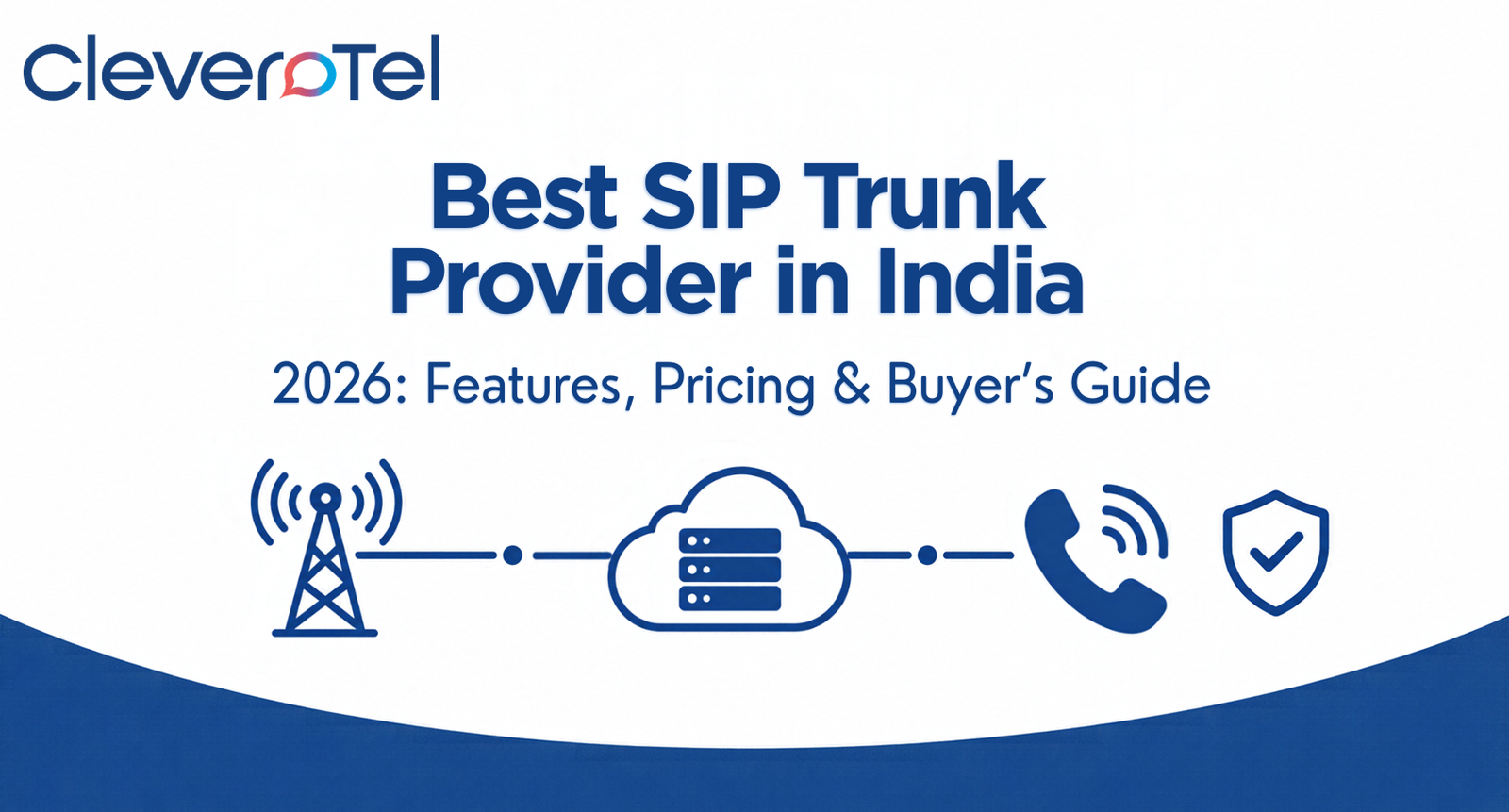
Best SIP Trunk Provider in India (2026): Features, Pricing & Buyer’s Guide

For most Indian businesses wanting SIP trunking bundled with an easy-to-manage cloud platform, CleveroTel offers DoT-aligned SIP connectivity with CRM integration and fast setup, without the engineering overhead larger carriers require. For enterprises with existing large-scale infrastructure, telecom-grade carriers like Tata Communications, Airtel Business, and Reliance Jio offer carrier-direct SIP trunks backed by national network infrastructure. Developer-first teams often look at Twilio, Plivo, or DIDlogic for API-driven trunking, while BSNL Enterprise SIP remains a budget option for government and large domestic institutions. The right choice depends on whether you want a managed, bundled service or direct carrier-level control.
Why SIP Trunk Provider Choice Actually Matters
Picking a SIP trunk provider isn’t just a connectivity decision it determines your call quality, your compliance exposure, and how much engineering effort your team has to put in just to keep calls working reliably. A provider with weak redundancy or unclear DoT licensing can leave a business with dropped calls during peak hours or, worse, real regulatory risk around call termination. This guide compares the leading options in India across compliance, features, and who each one actually suits.
What to Check Before Choosing a SIP Trunk Provider
- DoT/TRAI licensing — confirm the provider holds, or operates under, a valid ILD/NLD license for the call types you need.
- Redundancy and uptime — ask for a published SLA, not just a verbal “99.9% uptime” claim.
- PBX compatibility — confirm support for your existing system (Asterisk, FreePBX, 3CX, or a cloud PBX).
- Integration needs — CRM sync and call analytics matter if your team isn’t purely technical.
- Support model — API-first providers often assume in-house engineering capacity; managed providers handle more of this for you.
At-a-Glance Comparison
| Provider | Type | Pros | Cons | Best For |
|---|---|---|---|---|
| CleveroTel | Managed cloud + SIP | DoT-aligned, CRM-integrated, fast setup | Newer brand vs. legacy telecom carriers | SMBs & mid-market wanting a managed platform |
| Tata Communications | Telecom carrier | National infrastructure, enterprise SLAs | Slower onboarding, enterprise-focused pricing | Large enterprises with existing Tata relationships |
| Airtel Business | Telecom carrier | Carrier-grade reliability, pan-India reach | Less startup-friendly, longer setup cycles | Large enterprises, corporate PBX deployments |
| Reliance Jio SIP Trunk | Telecom carrier | Competitive domestic pricing, wide coverage | Enterprise support can be slower for SMBs | Businesses already on Jio’s network ecosystem |
| BSNL Enterprise SIP | Government carrier | Affordable, reliable domestic coverage | Limited integrations, basic feature set | Government bodies, large domestic institutions |
| CloudConnect | Licensed VNO | India-licensed B2B digital telco, CRM-ready | Enterprise-focused, less SMB-friendly pricing | Mid-to-large businesses wanting a licensed Indian VNO |
| FreJun | SaaS/CPaaS | AI transcription, CRM sync, INR pricing | Smaller support footprint than legacy carriers | Sales teams wanting CRM-native calling |
| Twilio | Global CPaaS | Powerful APIs, global reach | Requires engineering resources, costlier at scale | Developer-heavy teams building custom call flows |
| Plivo | Global CPaaS | Competitive INR-denominated pricing | Less India-specific compliance handholding | Cost-conscious developer teams |
| DIDlogic | Global SIP provider | Broad India city coverage, PBX-agnostic | Less localized support than Indian-first providers | Businesses wanting flexible, carrier-agnostic trunking |
Comparison reflects an editorial assessment based on publicly available information as of September 2026 — always confirm current pricing, SLAs, and licensing directly with each provider.
Provider Breakdowns
1. CleveroTel
CleveroTel bundles SIP trunking into its Cloud PBX platform, so businesses get DoT-aligned voice connectivity, IVR, call recording, and CRM/WhatsApp integration without separately sourcing or managing SIP trunks. It’s built for businesses that want reliable calling infrastructure without taking on the engineering overhead that API-first or carrier-direct providers typically require.
Pros: DoT/TRAI-aligned infrastructure, fast setup, native CRM integration, transparent plans on the pricing page
Cons: Newer brand relative to decade-old telecom carriers
Best for: SMBs and mid-market businesses wanting a managed, all-in-one calling platform
2. Tata Communications
Tata Communications, through its Kaleyra Cloud Voice offering, delivers carrier-grade SIP trunking backed by national telecom infrastructure, suited to businesses needing global reach alongside domestic coverage.
Pros: Enterprise-grade reliability, global + domestic coverage Cons: Onboarding and support cycles tend to favor large enterprise accounts Best for: Large enterprises with multi-country operations
3. Airtel Business
Airtel’s enterprise SIP offering leverages its carrier network directly, often deployed over dedicated circuits (ILL/MPLS) for corporate PBX environments.
Pros: Carrier-grade reliability, strong pan-India network presence
Cons: Less suited to fast-moving startups needing quick iteration
Best for: Large enterprises already using Airtel’s broader business services
4. Reliance Jio SIP Trunk
Jio’s SIP trunking service connects IP-PBX systems over a single link, leveraging Jio’s extensive domestic network footprint.
Pros: Competitive domestic pricing, wide network coverage
Cons: Enterprise support processes can feel slower for smaller businesses
Best for: Businesses already integrated into Jio’s broader connectivity ecosystem
5. BSNL Enterprise SIP
As a government-operated carrier, BSNL offers SIP trunking primarily for large organizations and public institutions needing cost-effective domestic connectivity.
Pros: Affordable, dependable domestic coverage
Cons: Limited integrations and a more basic feature set than private providers
Best for: Government bodies and large domestic institutions
6. CloudConnect
CloudConnect positions itself as a licensed B2B digital telco (VNO) in India, offering carrier-grade SIP trunking with CRM-ready integrations and multi-carrier redundancy.
Pros: Indian-licensed VNO status, built-in redundancy
Cons: Pricing and onboarding skew toward enterprise accounts
Best for: Mid-to-large businesses wanting a licensed Indian carrier alternative to global players
7. FreJun
FreJun combines SIP trunking with AI call transcription and native CRM sync (Salesforce, HubSpot, Zoho), priced in INR for the Indian market.
Pros: CRM-native workflow, AI transcription, local pricing
Cons: Smaller dedicated support footprint than legacy telecom carriers
Best for: Sales teams wanting calling built directly into CRM workflows
8. Twilio
Twilio’s Elastic SIP Trunking is a globally recognized, API-driven option, popular with engineering-heavy teams building custom call infrastructure.
Pros: Extremely flexible APIs, global reach
Cons: Requires in-house engineering resources; costs can scale quickly
Best for: Developer teams building fully custom call flows
9. Plivo
Plivo offers API-driven SIP trunking with INR-denominated pricing, positioned as a cost-effective alternative to Twilio for India-based deployments.
Pros: Competitive pricing, developer-friendly APIs
Cons: Less India-specific compliance guidance than local-first providers
Best for: Cost-conscious developer teams needing programmable trunking
10. DIDlogic
DIDlogic provides SIP trunking with broad coverage across Indian metro and Tier-2 cities, integrating with both on-premise PBX systems (Asterisk, 3CX) and cloud platforms.
Pros: Wide city coverage, PBX-agnostic flexibility
Cons: Less localized, India-first support compared to domestic providers
Best for: Businesses wanting flexible, carrier-agnostic SIP trunking
Is SIP Trunking in India Regulated?
Yes. Terminating or carrying long-distance voice traffic in India requires the underlying carrier to hold the appropriate DoT license typically ILD (International Long Distance) or NLD (National Long Distance), depending on call type. Businesses should confirm a provider’s licensing status directly rather than assuming compliance, and check TRAI guidelines for number series and call-routing rules relevant to their use case.
Frequently Asked Questions
What is the best SIP trunk provider in India for small businesses?
For small and mid-sized businesses wanting a managed, easy-to-set-up option, CleveroTel offers DoT-aligned SIP trunking bundled with CRM integration, without requiring dedicated engineering resources.
Are SIP trunk providers in India legally regulated?
Yes — carriers terminating long-distance voice traffic need appropriate DoT licensing (ILD/NLD), and providers should comply with TRAI’s number-series and routing regulations.
How much does SIP trunking cost in India?
Pricing varies widely from budget domestic options around ₹500–₹1,000 per month for basic trunks to enterprise carrier plans ranging from ₹2,800–₹15,000+ per month, depending on channel capacity and features.
Do I need an existing PBX to use SIP trunking?
Yes, SIP trunking connects to an existing on-premise or virtual PBX. If you don’t have one, a fully managed cloud telephony platform is usually the simpler starting point.
Can global providers like Twilio or Plivo legally serve Indian businesses?
They can, but businesses should confirm the provider’s compliance with Indian DoT/TRAI requirements for call termination, as regulatory handling can differ from India-first providers.
Conclusion
The “best” SIP trunk provider in India depends heavily on whether you want a fully managed platform or direct carrier-level control. CleveroTel suits businesses wanting SIP trunking bundled into a compliant, easy-to-manage cloud platform, while large enterprises with existing infrastructure may lean toward Tata Communications, Airtel, or Jio, and developer-heavy teams may prefer Twilio or Plivo for programmable flexibility.