Cloud Call Center vs Traditional Call Center in India: Which One Should You Choose?

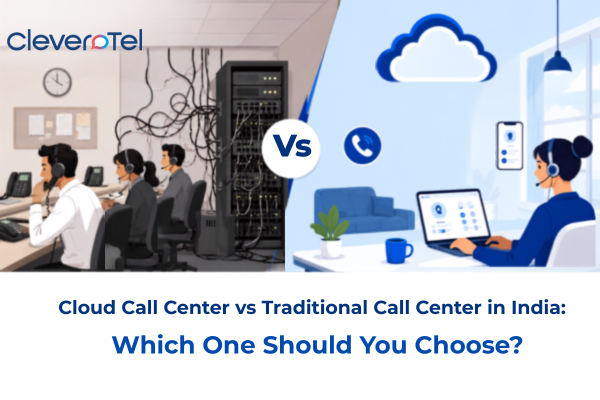
For most Indian businesses in 2026, a cloud call center is the better choice — it costs 60–80% less to set up, deploys in days instead of months, and supports remote agents natively. A traditional, on-premise call center still makes sense for a small number of large enterprises with strict data-residency needs, existing PBX investments they haven’t depreciated, or ultra-high-volume, single-site operations. For nearly every small and mid-sized business, the cloud model wins on cost, speed, and flexibility.
The rest of this guide breaks down exactly why, with real cost ranges and a decision framework so you can apply it to your own team.
What Is a Traditional Call Center?
A traditional call center runs on physical, on-premise infrastructure: an EPABX box, PRI phone lines, dedicated servers, and agents seated in one physical location. All routing, recording, and reporting hardware lives on-site, managed by an in-house IT team. Setup typically takes weeks to months and requires significant upfront capital for equipment and office space.
What Is a Cloud Call Center?
A cloud call center (also called CCaaS — Contact Center as a Service) delivers the same functions — IVR, call routing, recording, analytics through software hosted on remote servers and accessed over the internet. Agents can log in from any location on a laptop or the provider’s mobile app, and businesses pay a subscription fee rather than buying hardware outright.
Cloud vs. Traditional Call Center: Side-by-Side Comparison
| Factor | Traditional Call Center | Cloud Call Center |
|---|---|---|
| Setup time | Weeks to months | Hours to a few days |
| Upfront cost | High (EPABX, PRI lines, servers) | Minimal — subscription-based |
| Remote agent support | Not possible without VPN workarounds | Native — works from any device |
| Scalability | Slow; requires new hardware/lines | Instant — add or remove seats anytime |
| Call recording & analytics | Manual, often add-on hardware | Built-in, automated dashboards |
| Disaster recovery | Vulnerable — single physical site | Resilient — cloud redundancy |
| Maintenance | Requires dedicated IT staff | Handled by the provider |
| Omnichannel (WhatsApp, chat, SMS) | Rare, needs separate systems | Usually native or integrated |
| Best suited for | Large, single-site enterprises with legacy investment | Startups, SMBs, distributed teams, BFSI, e-commerce, real estate |
Cost Comparison in the Indian Market
This is usually the deciding factor for Indian businesses, so it’s worth being specific:
- Traditional setup: EPABX hardware, PRI line installation, server room, and IT staffing can run into several lakhs upfront, plus ongoing AMC (annual maintenance contract) costs regardless of call volume.
- Cloud setup: Most Indian providers price per-agent, typically in the ₹1,500–₹10,000/month range depending on features, with per-minute call charges layered on top. There’s no hardware to depreciate and no AMC.
The practical effect: a 10-agent traditional call center can require ₹8–15 lakh in initial investment before the first call is answered, while an equivalent cloud setup can go live the same week for a fraction of that, converting a large capital expense into a predictable monthly operating cost. You can see live, India-specific plan pricing on CleveroTel’s pricing page.
Why Cloud Is Winning in India Specifically
Three factors make the Indian market particularly suited to cloud call centers:
- A mobile-first, distributed workforce. Sales and support talent increasingly sits in Tier-2 and Tier-3 cities, not just metros. Cloud platforms let businesses hire from anywhere without opening a second office.
- India’s scale as a services hub. India’s call and contact center outsourcing market is projected to nearly triple from roughly USD 3.86 billion in 2024 to USD 9 billion by 2030 growth that on-premise infrastructure simply can’t scale to meet at the same speed as cloud deployment.
- Regulatory alignment. Reputable cloud providers build TRAI and DoT compliance correct number series, DND scrubbing, consent logging directly into the platform, which is harder to retrofit onto legacy on-premise systems.
When Does a Traditional Call Center Still Make Sense?
Cloud isn’t universally the answer. A traditional or hybrid setup can still be justified when:
- You operate in a heavily regulated sector with strict on-premise data-residency mandates that a specific cloud vendor can’t yet meet.
- You’ve already sunk capital into EPABX hardware that hasn’t been depreciated and internet reliability at your site is a genuine concern.
- You run a single, very large, single-location operation where per-seat cloud pricing at extreme scale no longer beats owned infrastructure.
For everyone else which is the overwhelming majority of small and mid-sized Indian businesses the math and the flexibility favor cloud.
How to Choose the Right Cloud Call Center Provider
- Check compliance first. Confirm DoT/TRAI-aligned infrastructure before evaluating features.
- Match features to your call volume. A 5-agent support team doesn’t need predictive dialing; a 50-agent outbound sales team does.
- Look for omnichannel support. Voice plus WhatsApp Business messaging in one inbox reduces tool-switching and missed follow-ups.
- Verify uptime SLAs. 99.9%+ should be the baseline, not a premium add-on.
- Test the analytics dashboard. Real-time call monitoring and AI-generated call summaries save hours of manual review weekly.
CleveroTel’s AI Cloud Call Center is built around exactly this checklist inbound and outbound support, AI-powered routing, real-time agent monitoring, and 100+ CRM integrations, deployable without any on-site hardware. For businesses that need a simpler setup first, the Cloud PBX and Virtual Reception products cover smaller teams that aren’t yet running a full contact center.
Frequently Asked Questions
Is a cloud call center cheaper than a traditional call center in India?
Yes. Cloud call centers eliminate upfront hardware costs and typically run on a per-agent subscription of ₹1,500–₹10,000/month, versus several lakhs in initial investment for a traditional on-premise setup.
Can a cloud call center support remote or work-from-home agents?
Yes this is one of its core advantages. Agents can log in from any device with an internet connection, unlike traditional systems tied to a physical location.
Is cloud calling legal and compliant in India?
Yes, when the provider is DoT-licensed (or partners with one) and follows TRAI rules on number series, DND compliance, and consent for call recording.
How long does it take to set up a cloud call center vs. a traditional one?
A cloud call center can typically go live within days; a traditional setup usually takes several weeks to months due to hardware procurement and installation.
Conclusion
For the vast majority of Indian businesses startups, SMBs, BFSI, e-commerce, and distributed sales teams – a cloud call center delivers lower cost, faster deployment, and built-in remote support that traditional infrastructure can’t match without significant added expense. Traditional setups still have a narrow, legitimate use case, but for most teams the decision isn’t close.
Ready to see the difference in your own operations? Book a free consultation with CleveroTel