Cloud Telephony for Small Business in India: Complete Guide, Benefits & Costs

If your team is still juggling personal SIM cards, missed calls, and no record of what was promised to a customer, you’re not alone. India has over 7.47 crore MSMEs, and the vast majority still run on fragmented, mobile-first communication even though it costs them leads every single day.
Cloud telephony fixes this without a single wire being laid. This guide covers what it is, why it matters for small businesses specifically, what it actually costs in India in 2026, and how to choose a provider that won’t lock you into hardware you’ll outgrow in a year.
What Is Cloud Telephony?
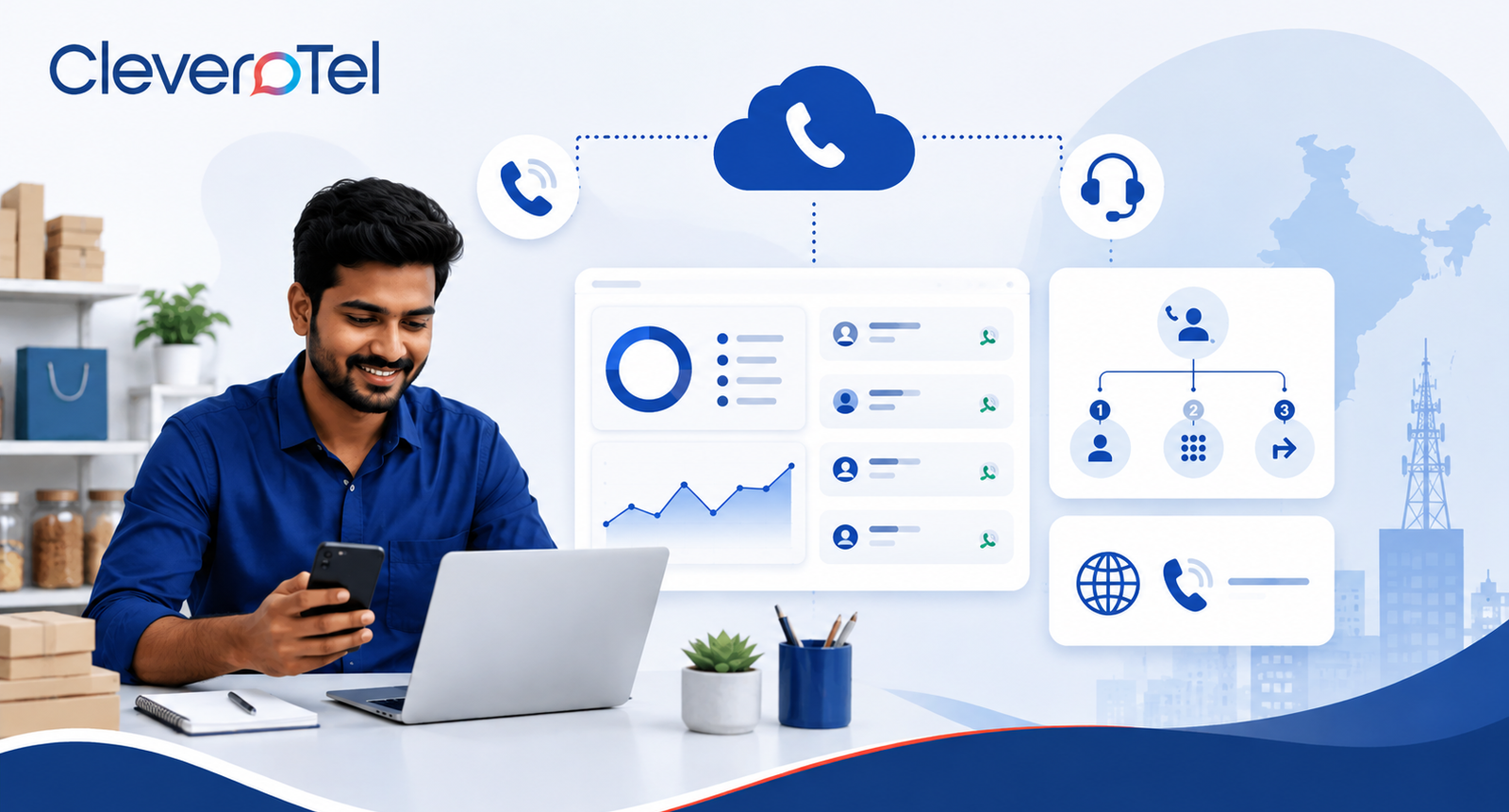
Cloud telephony is a phone system hosted entirely on remote servers instead of an on-premise EPABX box. Calls travel over the internet (VoIP) or a hybrid PSTN-cloud route, and features like IVR, call routing, recording, and analytics run through a web dashboard rather than physical wiring.
In practice, this means a 5-person business can have a professional business number, a multi-level IVR (“Press 1 for Sales, Press 2 for Support”), and call recording live in under an hour no engineer visit required.
Why Small Businesses in India Need It Now
Three shifts have made this urgent rather than optional:
- Customers call before they buy. Most Indian consumers still prefer a phone call over chat or email before making a purchase decision, especially for services, real estate, and healthcare.
- Remote and hybrid teams are permanent. A cloud number lets a sales rep in Pune and a support agent in Kochi share the same business line without either owning a landline.
- Missed calls are lost revenue. Without call routing and voicemail-to-inbox, a call outside business hours or during a busy period simply disappears along with the lead.
Key Benefits of Cloud Telephony for Small Businesses
1. Zero Hardware, Low Upfront Cost
There’s no EPABX, no wiring, and no AMC for physical equipment. You pay for a subscription and scale users up or down as needed a critical advantage for businesses managing tight working capital.
2. Professional Image From Day One
A local or toll-free virtual number with a custom IVR menu makes a 3-person startup sound as organised as an enterprise. This alone improves conversion on inbound sales calls.
3. Never Miss a Lead
Smart call routing sends calls to the next available agent, and missed-call alerts plus voicemail transcription mean no enquiry falls through the cracks even after hours.
4. Call Recording and Quality Monitoring
Every conversation can be recorded and reviewed, which is invaluable for training new hires, resolving disputes, and maintaining service quality without micromanaging.
5. CRM and WhatsApp Integration
Modern platforms sync call data directly into tools like Zoho, HubSpot, or Salesforce, and combine voice with WhatsApp Business messaging so every customer touchpoint sits in one thread instead of scattered across apps.
6. Actionable Analytics
Dashboards showing call volume, missed-call rate, and agent performance let owners spot problems like an under-staffed peak hour that are invisible on a personal phone bill.
7. Built to Scale
Adding ten new agents during a festive sales spike takes minutes on a cloud system, versus weeks of procurement for physical phone lines.
Cloud Telephony Cost in India: What to Actually Expect
Pricing varies by provider and usage, but for a small business team, realistic 2026 ranges look like this:
| Component | Typical Cost (₹) |
| Virtual number + basic IVR plan | ₹1,500 – ₹4,000/month for small teams |
| Mid-tier plan (call center features, CRM sync) | ₹4,000 – ₹10,000/month |
| Per-minute call rates | ₹0.30 – ₹1.50/minute depending on call type |
| Toll-free number | Additional monthly rental + per-minute inbound cost |
| Enterprise/contact centre setup | Custom quote based on agents and integrations |
Most providers charge per-agent or per-line, so the real driver of your monthly bill is headcount, not the platform itself. Compare this to a traditional EPABX setup, where upfront hardware alone can run into lakhs before you’ve made a single call cloud telephony converts that capital expense into a predictable operating one. You can see a transparent, India-specific breakdown on CleveroTel’s pricing page.
Is Cloud Telephony Legal and Compliant in India?
Yes when sourced through the right channel. Cloud telephony and virtual numbers in India operate under rules set by the Telecom Regulatory Authority of India (TRAI) and the Department of Telecommunications (DoT). A compliant provider will:
- Operate as, or partner with, a DoT-licensed telecom operator (typically a Unified License-VNO)
- Use the correct TRAI number series for the call type (for example, 140-series for promotional calls, 1600-series for transactional/service calls)
- Follow KYC norms when issuing a business number
- Handle call recording and data storage in line with consent requirements
Before signing up with any provider, ask directly whether they hold DoT/TRAI authorisation this single question filters out a lot of grey-market resellers.
Cloud Telephony vs. Traditional Phone Systems
| Factor | Traditional EPABX | Cloud Telephony |
| Setup time | Days to weeks | Minutes to hours |
| Upfront cost | High (hardware, wiring) | Minimal to none |
| Remote access | Not possible | Built-in |
| Call recording/analytics | Rare, manual | Standard, automated |
| Scaling up/down | Slow, physical | Instant, self-serve |
How to Choose the Right Provider
- Confirm compliance — DoT/TRAI licensing, as above.
- Check uptime guarantees — look for a published SLA (99.9%+ is standard among established providers).
- Match features to your workflow — a retail business needs order-tracking IVR; a real estate agency needs lead routing and call-back automation.
- Test the mobile experience — if your team works from the field, the mobile app matters as much as the desktop dashboard.
- Look for CRM and WhatsApp support — fragmented tools cost more time than they save.
Solutions like CleveroTel’s Cloud PBX and Virtual Reception are built around this exact checklist — DoT-aligned infrastructure, sub-hour setup, and integrations with 100+ CRM and helpdesk tools, so small teams get enterprise-grade reliability without enterprise overhead. Businesses running structured inbound or outbound campaigns can also explore the AI Cloud Call Center for routing, monitoring, and reporting in one place.
Frequently Asked Questions
Is cloud telephony expensive for a small business?
No ,most small-team plans in India start under ₹4,000/month, well below the cost of a physical EPABX setup.
Can I use my existing mobile number with cloud telephony?
Yes, most providers let you forward or port calls, or run the cloud number alongside your existing line during transition.
Do I need technical staff to manage it?
No. Setup and IVR configuration are typically self-serve through a web dashboard, with provider support for anything advanced.
Conclusion
For India’s small business ecosystem, cloud telephony has moved from “nice to have” to basic infrastructure on par with having a website or a GST number. The businesses gaining ground aren’t necessarily spending more; they’re simply not losing calls, leads, and data the way a personal-mobile setup guarantees they will.
If you’re ready to see what a compliant, India-built cloud telephony setup looks like for your team, book a free consultation with CleveroTel or browse more guides on the CleveroTel blog.