Cloud PBX System for US IT Staffing Companies: What to Look For

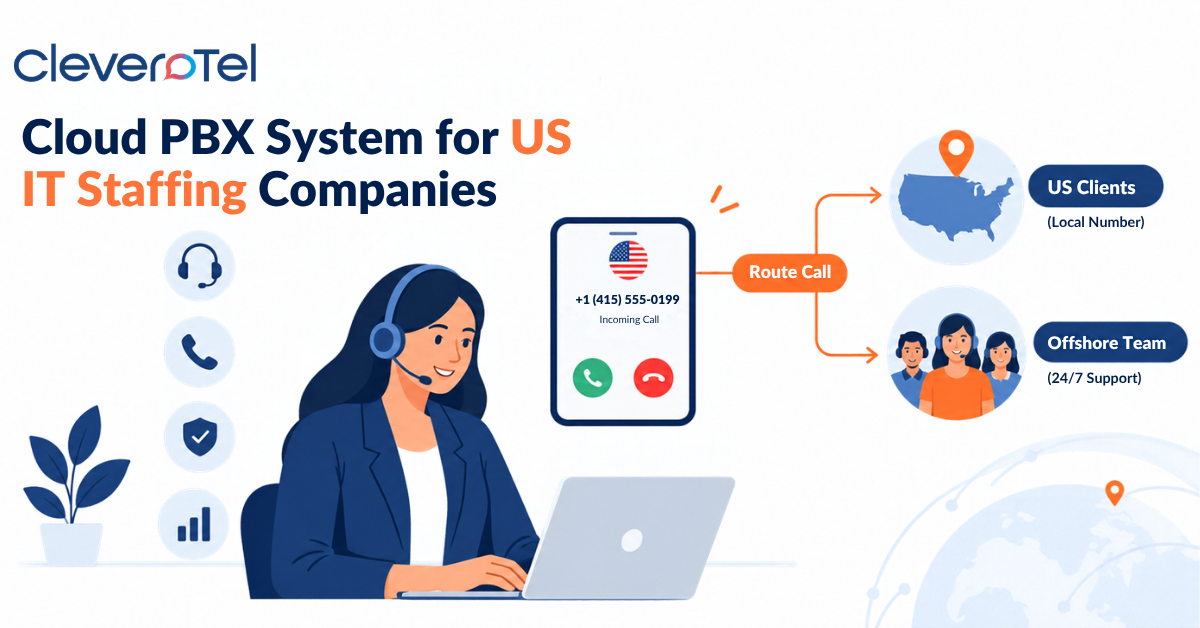
Table of Contents
- Introduction
- Why IT Staffing Firms Need a Cloud PBX
- 7 Cloud PBX Features US IT Staffing Companies Should Prioritize
- How to Choose and Roll Out a Cloud PBX: 5 Steps
- FAQs
- Conclusion
Introduction
Recruiting is a phone-driven business. A single IT recruiter can make 80 to 100 calls a day: sourcing candidates, confirming interviews, negotiating rates, and checking in with hiring managers. When your team is spread across US offices, remote hires, and offshore delivery centers, a traditional desk phone setup quickly becomes the bottleneck.
A cloud PBX system moves your entire phone system to the internet. Numbers, extensions, call routing, recording, and reporting all run from one dashboard, with no on-site hardware to buy or maintain. This guide explains why it suits US IT staffing companies and which features matter most when you compare providers.
Why IT Staffing Firms Need a Cloud PBX
Staffing has a few traits that make legacy phone systems a poor fit:
- Distributed teams. Many US staffing firms run recruiting or sourcing desks from India or other offshore locations to cover more time zones and control costs. Those recruiters still need to appear as a US business to candidates.
- Caller trust. US candidates are wary of unknown or international numbers. A local area-code number gets picked up far more often than an overseas one.
- High call volume, high accountability. Clients and compliance teams expect a record of what was said on a call, and managers need to see who is calling whom, and how often.
- Fast scaling. Staffing demand swings with hiring cycles. Adding 10 recruiters for a big client requisition shouldn’t mean buying 10 desk phones and waiting for installation.
- Predictable costs. Cloud plans are usually priced per user, so you pay for the seats you use instead of investing in hardware that sits idle between hiring peaks.
A cloud PBX handles all five without heavy setup or upfront hardware spend.
7 Cloud PBX Features US IT Staffing Companies Should Prioritize
1. Local US Numbers for Every Recruiter
Give each recruiter or team a US number in the area code that matches your target market, such as a Texas number for Dallas-based clients or a New Jersey number for tri-state hiring. Candidates see a domestic call, not an international one, and answer rates typically improve. Recruiters working from India can call US candidates and clients on local US numbers, so the call looks made from within the US.
Resources for choosing numbers:
- FCC: Call authentication (STIR/SHAKEN), which explains how caller ID trust works in the US
- CleveroTel: Best Virtual Number Provider in India
2. Call Recording and Transcription
Recording lets managers review how recruiters pitch roles, and it gives you a record when a candidate disputes rates or availability. Look for searchable recordings and, ideally, automatic transcripts so you don’t have to listen to hours of audio to find one conversation.
3. CRM and ATS Integration
Recruiters live inside an applicant tracking system or CRM. Your phone system should log calls to candidate and client records automatically, and support click-to-call from the record. Without this, call notes get lost or entered late. Confirm which integrations a provider supports before you commit.
4. Auto Dialer and Click-to-Call
Outbound sourcing is repetitive. A dialer that queues candidate lists, skips busy numbers, and logs outcomes can save recruiters hours every week. Check that the dialer respects US calling rules for the type of outreach you do.
Resources for calling compliance:
- FCC: Stop unwanted robocalls and texts
- American Staffing Association, an industry body with staffing best-practice resources
5. Smart Call Routing and IVR
Clients, candidates, and consultants on assignment all call for different reasons. An IVR menu (“Press 1 for open roles, press 2 for payroll”) sends each caller to the right team. Time-based routing forwards calls to whichever office is open, which helps a firm covering both US and offshore hours.
6. Remote and Offshore Team Support
Because the system is cloud-based, a recruiter can take calls from a laptop or mobile app anywhere with internet access. Extension-to-extension calling between US and offshore staff should be free and instant, so a US account manager can transfer a client call to a technical recruiter overseas without any visible seam. Strong call quality matters here, so ask providers how they handle bandwidth and network reliability.
7. Reporting and Analytics
Track calls made, talk time, answer rates, and missed calls per recruiter and per client account. This tells you which recruiters need coaching, which time slots get the best pickup rates, and whether missed client calls are costing you placements.
How to Choose and Roll Out a Cloud PBX: 5 Steps
- Map your call flows. List who calls whom: recruiters to candidates, account managers to clients, consultants to support. Your routing rules come from this.
- Decide your number strategy. Choose which US area codes you need, and whether recruiters share numbers or get their own.
- List your must-have integrations. Start with your ATS or CRM, then add anything for messaging or reporting.
- Run a pilot. Test with one recruiting pod for two to three weeks and compare answer rates and call quality against your old setup.
- Train and roll out in phases. Move team by team, and keep your old numbers forwarding to the new system until candidates and clients are used to the change.
FAQs
What is a cloud PBX system?
A cloud PBX is a business phone system hosted online rather than on hardware in your office. It handles extensions, call routing, voicemail, recording, and reporting through a web dashboard and apps.
Can an offshore recruiting team use US numbers?
Yes. With virtual US numbers on a cloud PBX, recruiters in another country can make and receive calls that appear to come from a US area code. Your provider should confirm the number type and any compliance requirements for your use.
How is a cloud PBX different from a traditional PBX for a staffing firm?
A traditional PBX needs on-site hardware and technicians, and scaling means buying more equipment. A cloud PBX scales by adding users online, supports remote teams by default, and usually costs less to run.
Do we need a dialer as well?
It depends on how much outbound sourcing you do. High-volume desks often benefit from a dialer built into the cloud PBX, while smaller teams may only need click-to-call.
Conclusion
For US IT staffing companies, the phone system shapes how quickly recruiters reach candidates and how professional a firm looks to clients. A cloud PBX with local US numbers, ATS integration, recording, and clear reporting suits distributed and offshore teams especially well, and it grows with you as hiring demand rises and falls.
If you’re still weighing providers, read our guide to a Cloud PBX provider in India or talk to CleveroTel’s team about a setup built around your recruiting workflow.