Best Virtual Number Provider in India (2026): Features, Pricing & Buyer’s Guide

What if your business could answer every customer call, from any city in India, without buying a single SIM card?
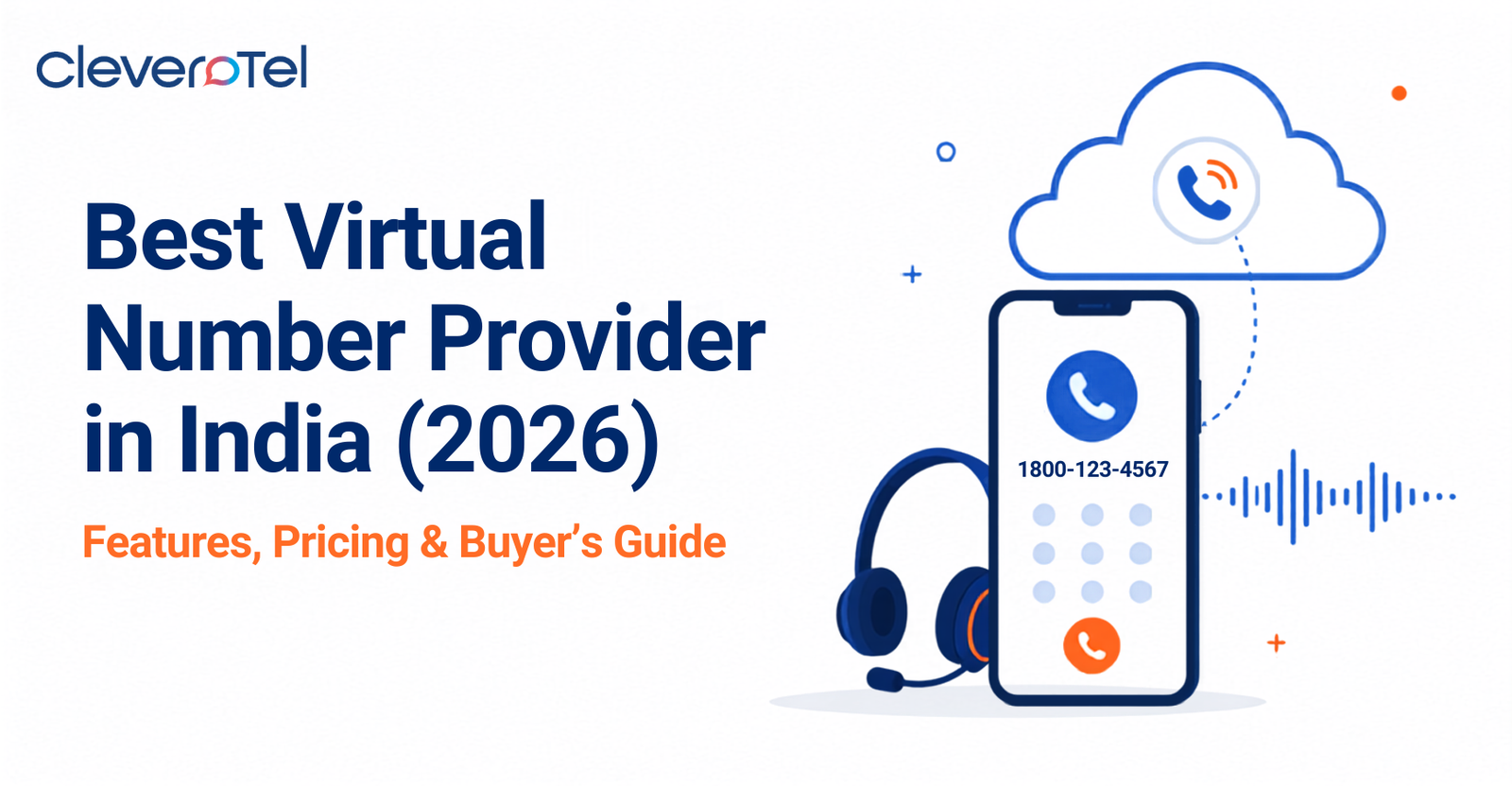
That’s the promise of a virtual number. Instead of routing calls through a physical landline or a stack of mobile connections, a virtual number runs entirely over the internet, letting a business look local in Mumbai, Delhi, or Bangalore while its team sits anywhere.
For growing Indian businesses, this means a professional local presence, easier call tracking, and communication that scales without adding hardware. But with dozens of providers now competing for the same customers, picking the right one isn’t straightforward.
In this guide, we break down what a virtual number actually is, how to evaluate providers, pricing patterns to expect, and 12 of the best virtual number providers in India for 2026.
What Is a Virtual Number?
A virtual number is a phone number that isn’t tied to a SIM card, landline, or any physical device. It runs on VoIP (Voice over Internet Protocol) technology, so calls are routed over the internet to whichever phone, laptop, or app the business connects it to.
Modern virtual number platforms typically combine:
- Cloud PBX to manage inbound and outbound calling without on-site hardware
- IVR (Interactive Voice Response) to route callers automatically
- Call recording and analytics for quality checks and reporting
- CRM and helpdesk integrations so call activity syncs with existing tools
- Multi-city and international number provisioning, including local numbers in other countries
This lets a business move beyond “just answering the phone” toward running structured, trackable call workflows.
How Do Virtual Numbers Benefit Indian Businesses?
1. Local Presence Without a Local Office A business can offer a Mumbai or Chennai number to customers in that city, even if the team works out of a single head office or remotely.
2. Call Tracking for Marketing Every campaign, landing page, or ad can carry its own trackable number, showing exactly which channel is driving calls.
3. Lower Setup and Maintenance Costs No SIM cards, no EPABX hardware, no line rentals per branch — numbers are provisioned and managed from a dashboard.
4. Business Continuity Calls can be rerouted instantly if a line goes down, a team member is unreachable, or an office relocates.
5. Professional Call Handling Custom greetings, IVR menus, call queues, and recorded calls create a more consistent customer experience than personal mobile numbers.
6. Easy Scalability Adding a new number, city, or agent is a dashboard action, not a hardware order — useful for BPOs, IT teams, and hospitals managing seasonal or growing call volumes.
How to Choose the Right Virtual Number Provider
1. Define Your Use Case Customer support, sales outreach, appointment booking, international calling, or a call center rollout each favor different feature sets decide this first.
2. Check Number Types Available Local city numbers, toll-free (1800) numbers, and international numbers (including the ability to call abroad using a local number from that country) serve very different purposes.
3. Evaluate Call Quality and Uptime Ask for uptime guarantees and, where possible, test call quality before committing to an annual plan.
4. Look at Integrations Confirm the provider connects with your CRM, helpdesk, or ERP — a number that can’t sync with existing systems creates manual work.
5. Review Compliance and Data Security For hospitals and BPOs handling sensitive data, check data retention policies, encryption, and TRAI compliance for number porting and DND regulations.
6. Consider Support Quality 24/7 support matters more than it seems until a business-critical line goes down outside working hours.
7. Compare Full Pricing, Not Just the Headline Rate Look beyond the base plan at per-minute charges, number rental, concurrent call limits, setup fees, and costs for add-ons like call recording or analytics.
12 Best Virtual Number Providers in India (2026)
The right provider depends heavily on the job at hand — a startup testing outbound sales and a hospital running a 24/7 patient helpline need very different setups. Here are 12 notable virtual number providers to consider.
1. CleveroTel — Best for Businesses Calling Internationally from India
For Indian businesses that regularly call the US, UK, or other overseas markets, CleveroTel is built around a specific advantage: making those calls appear as if they’re placed from a local number in that country, rather than from India.
Alongside this, CleveroTel offers cloud PBX infrastructure suited to BPOs, IT companies, and hospitals that need reliable, trackable calling without maintaining on-premise equipment.
Key Features
- Local numbers in the US and other countries for outbound and inbound calling
- Cloud PBX with no hardware setup
- Call recording and analytics
- CRM integrations
- Scalable multi-agent and multi-branch support
- Dedicated onboarding and support for BPO, IT, and healthcare teams
Best For BPOs, IT companies, and hospitals in India that call international clients or patients regularly and want those calls to land as local, not overseas.
2. Knowlarity — Best for AI-Driven Call Automation
Knowlarity leans heavily into automation, offering IVR, voicebots, and analytics aimed at businesses that want to reduce manual call handling.
Best For: Businesses wanting AI-assisted call routing and automation at scale.
3. MyOperator — Best for Marketing Call Tracking
MyOperator is widely used for tracking calls generated by marketing campaigns, with call analytics tied closely to lead sources.
Best For: Marketing teams that need to attribute inbound calls to specific campaigns.
4. Exotel — Best for High-Volume Inbound Calling
Exotel is an established Indian cloud telephony provider built for businesses managing large volumes of inbound calls with strong reliability requirements.
Best For: India-based businesses running high-volume customer support lines.
5. Ozonetel — Best for Contact Center Operations
Ozonetel combines virtual numbers with a fuller contact-center stack, including auto-dialers and agent management tools.
Best For: Businesses building out a dedicated call center function.
6. Servetel (Acefone) — Best for Small and Remote Teams
Servetel, operating under the Acefone brand, is positioned for smaller and distributed teams that need straightforward cloud calling without heavy setup.
Best For: Small businesses and remote teams looking for a simple, low-maintenance setup.
7. TeleCMI — Best for Tech Teams and Developers
TeleCMI is geared toward technical teams, offering API access and developer-friendly tools for building custom calling workflows.
Best For: Product and engineering teams that want to build calling features into their own applications.
8. CallerDesk — Best for Startups and D2C Brands
CallerDesk is built specifically for Indian startups and D2C businesses, with an emphasis on fast setup and minimal onboarding friction.
Best For: Startups and D2C brands that want to go live with a business number quickly.
9. CallHippo — Best for Budget-Conscious Global Teams
CallHippo offers virtual numbers across many countries, including India, on plans aimed at startups and small teams working with global customers.
Best For: Small teams needing numbers in India and other markets under one platform.
10. RingCentral — Best for Unified Communications
RingCentral combines calling with team messaging and video conferencing, aimed at businesses that want one platform for all communication.
Best For: Mid-size to large teams that want calling bundled with broader collaboration tools.
11. 8×8 — Best for Enterprise Communication Stacks
8×8 provides enterprise-grade voice, video, and messaging, often chosen by larger organizations consolidating communication vendors.
Best For: Larger enterprises standardizing on a single communications provider.
12. Vonage — Best for Established VoIP Reliability
Vonage is a long-standing name in VoIP, known for stable call queuing and a broad set of enterprise features.
Best For: Businesses that prioritize a well-established VoIP provider with a long track record.
Typical Pricing Patterns to Expect
Pricing varies by provider and plan, but most Indian virtual number platforms charge along these lines:
- Number rental — a monthly or annual fee per local or toll-free number
- Per-minute call charges — for outbound (and sometimes inbound) calls, varying by destination
- Per-agent or per-seat fees — for platforms with multi-user dashboards
- Setup and onboarding costs — often waived by newer or startup-focused providers
- Add-on charges — for call recording storage, advanced analytics, or CRM integrations
Always ask for a full cost breakdown at expected call volumes rather than comparing base plan prices alone.
Conclusion
Virtual numbers have become core infrastructure for Indian businesses that want a professional, trackable, and scalable way to handle calls whether that’s a hospital managing patient calls, a BPO running support lines, or an IT company calling clients overseas.
The right provider should offer more than just a number: reliable call quality, the integrations a business already depends on, and support that shows up when something breaks.
For businesses that call international clients or patients regularly, CleveroTel is built around exactly that need letting Indian teams call the US and other countries using a local number, backed by cloud PBX infrastructure designed for BPOs, IT companies, and hospitals.
Looking to give your business a local number in the markets you serve? Reach out to CleveroTel to find the right virtual number setup for your team.