Toll-Free vs Virtual Number: Which Should Your Business Choose?

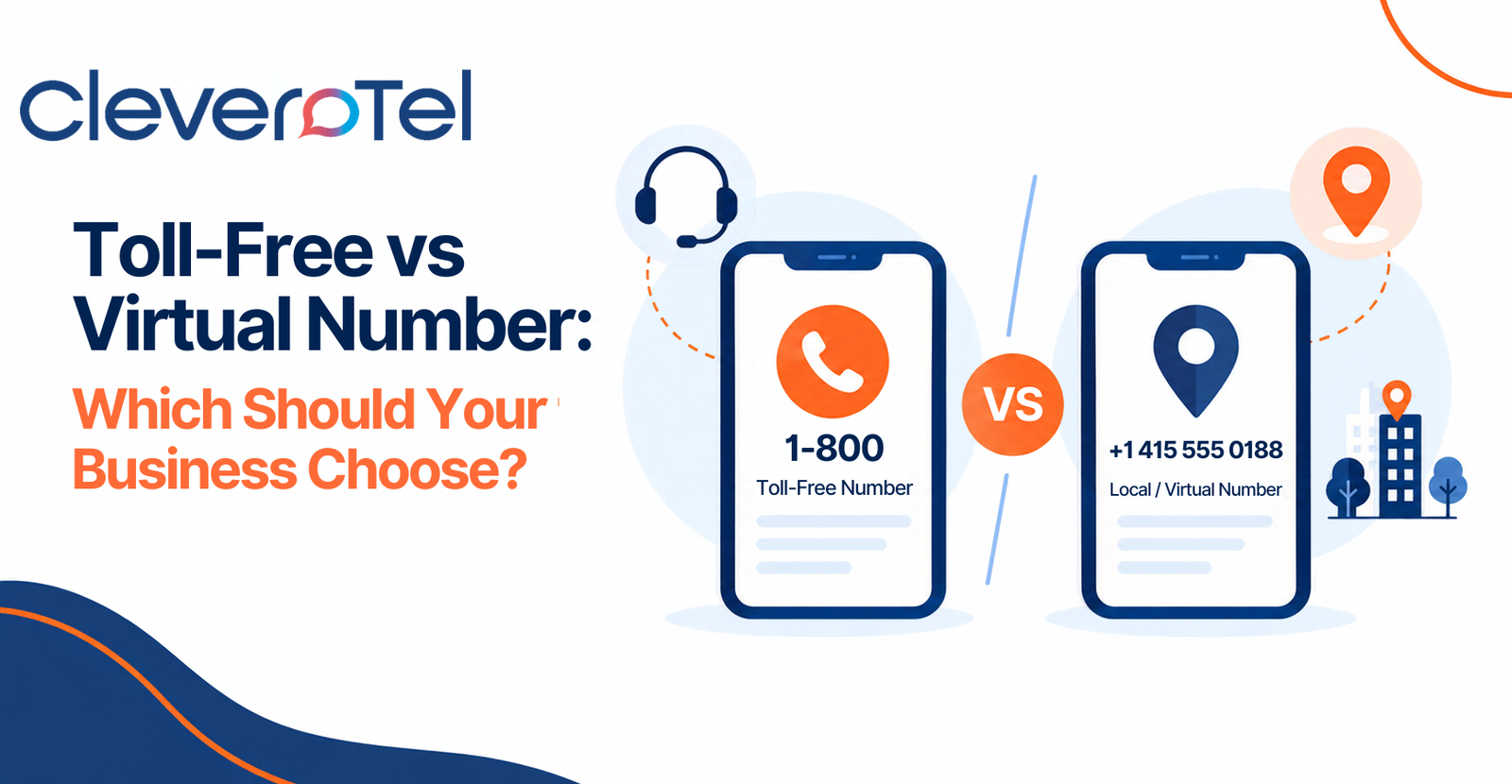
Table of Contents
- Introduction
- Why This Decision Matters
- What Is a Toll-Free Number?
- What Is a Virtual Number?
- Toll-Free vs Virtual Number: Side-by-Side Comparison
- Which One Fits Your Business? A 5-Step Decision Framework
- FAQs
- Conclusion
Introduction
If you’re setting up or upgrading your business communication system in India, you’ve likely run into two similar-sounding options: toll-free numbers and virtual numbers. Both let customers reach you without dialing a personal mobile line, both work over the cloud, and both show up looking “official” on caller ID. But they solve different problems.
This guide breaks down what each number type actually does, where they overlap, where they don’t, and how to decide which one (or both) your business needs with a specific look at what makes sense for IT companies and hospitals, two sectors where this choice comes up constantly.
If you’re still evaluating providers rather than number types, our guide to the best virtual number providers in India is a good companion read.
Why This Decision Matters
Picking the wrong number type doesn’t just cost you a support ticket later it affects your call costs, your customer’s first impression, and how well your team can track where leads are coming from.
A toll-free number tells a caller “this call costs you nothing,” which matters for consumer trust lines and grievance redressal. A virtual number tells a caller “this is a local, reachable business,” which matters for regional sales teams, patient follow-ups, and department-specific lines. Get this backwards and you either pay for calls you didn’t need to subsidize, or you lose the local trust factor that gets prospects to actually pick up.
For IT companies running multi-city sales teams and hospitals coordinating between departments and patients, the two number types often need to work together rather than as an either/or choice which is exactly why this comparison matters before you commit to a plan.
What Is a Toll-Free Number?
A toll-free number (in India, typically starting with 1800) is a number where the business pays for incoming calls, not the caller. It’s built for one purpose: removing any cost hesitation a customer might have before calling you.
Common use cases:
- National customer support and grievance lines
- Post-sale service and warranty claims
- Emergency or urgent-care contact lines for hospitals
- Brand-building for consumer-facing campaigns
Toll-free numbers work well when the caller is unknown to you and price-sensitive about calling which is why they’re standard for consumer support desks and hospital helplines that need to look accessible to anyone, anywhere in the country.
What Is a Virtual Number?
A virtual number is a cloud-hosted number — local, mobile, or international format that routes calls to your existing team without needing a physical SIM or landline at that location. It doesn’t have to be toll-free; the caller typically pays standard local rates.
Common use cases:
- Local presence in cities where you don’t have an office
- Department-specific lines (sales, billing, appointments)
- Call tracking for individual marketing campaigns
- International presence — for example, a business in India using a local US virtual number so outbound and inbound calls to American clients look domestic
Virtual numbers work well when you want to look local and reachable to a specific audience segment, or when you need to run and measure multiple campaigns without juggling multiple SIM cards.
Toll-Free vs Virtual Number: Side-by-Side Comparison
| Factor | Toll-Free Number | Virtual Number |
|---|---|---|
| Who pays for the call | Business | Caller (standard rates) |
| Best for | National support, brand trust | Local presence, campaign tracking |
| Setup cost | Generally higher, regulatory approval needed | Faster to provision |
| Ideal for IT companies | Enterprise support line | City-wise sales lines, US/international client lines |
| Ideal for hospitals | Patient helpline, emergency contact | Department lines (OPD, billing, diagnostics) |
| Scalability | Works best as one central number | Works best as multiple numbers per team/region |
| Caller perception | “This is free and official” | “This business is local to me” |
Neither option is universally “better” — the comparison only makes sense against what you’re trying to solve.
Which One Fits Your Business? 5-Step Decision Framework
- Map your caller type. Are most callers new/unknown (favor toll-free) or existing customers reaching a specific team (favor virtual)?
- Check your geography. Selling only within India nationally? Toll-free covers it. Selling regionally or internationally? Virtual numbers per market work better.
- Decide who should absorb call cost. High-volume consumer support usually justifies the business absorbing cost via toll-free. B2B and internal-facing lines rarely need this.
- Plan for tracking. If you’re running multiple campaigns or departments and need to measure each separately, virtual numbers make attribution far easier than one shared toll-free line.
- Consider running both. Many IT companies and hospitals use a toll-free number for the main support/helpline and virtual numbers underneath it for departments, cities, or campaigns — this is usually the most scalable setup on a cloud PBX system.
FAQs
Is a toll-free number more expensive than a virtual number?
Toll-free numbers usually cost more to run since the business absorbs call charges, plus they involve additional regulatory registration in India. Virtual numbers are typically cheaper to set up and maintain.
Can a hospital use both number types together?
Yes — this is actually the most common setup. A toll-free number handles the main patient helpline, while virtual numbers route calls to specific departments like billing, diagnostics, or appointment scheduling.
Do virtual numbers work for international clients?
Yes. A business in India can use a local virtual number in another country (like the US) so international clients see a familiar local number instead of an international one, improving pickup rates.
Which is better for a growing IT company’s sales team?
Virtual numbers, in most cases they let you assign a local-looking number per city or region and track which one is generating leads, which a single toll-free line can’t do as easily.
Conclusion
The real question isn’t “toll-free or virtual” — it’s what job you need the number to do. Toll-free numbers remove cost friction and build trust for support and helpline scenarios. Virtual numbers build local or international presence and make campaign tracking possible. Most growing IT companies and hospitals end up using both, layered on a single cloud PBX system rather than picking one and discarding the other.
If you’re ready to compare providers before setting either up, revisit our Best Virtual Number Provider in India guide for a full provider breakdown.
Have questions about setting up toll-free or virtual numbers for your business? Get in touch with CleveroTel’s team to find the right mix for your call volume and budget.